
Are you wondering how affiliate marketing and multi-level marketing (MLM) differ, and which one might be right for you? Both offer ways to earn money online, but they work in very different ways.
Understanding these differences can help you make smarter decisions about where to focus your time and energy. You’ll discover how affiliate marketing lets you earn commissions by promoting products, while MLM combines direct sales with building a team. You’ll learn about the costs, freedom, and income potential involved in each, so you can find the approach that fits your goals and lifestyle best.
Keep reading to clear up the confusion and gain clarity on which path could lead you to success.
Affiliate Marketing Basics
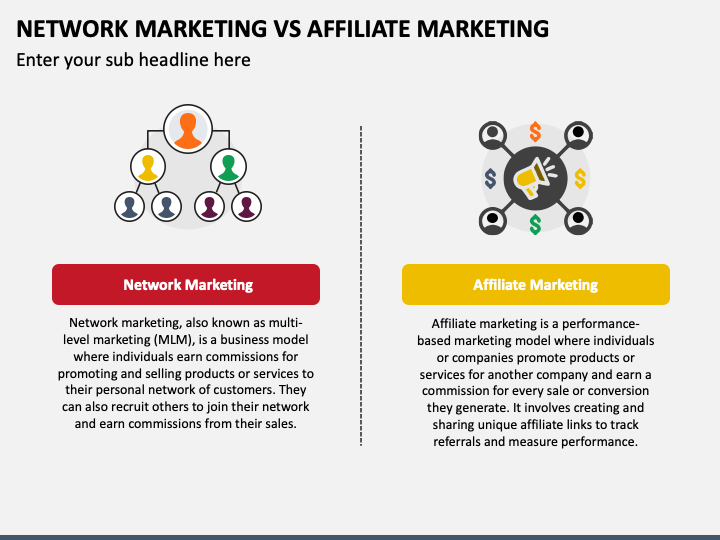
Affiliate marketing means earning money by sharing special links. When someone buys through your link, you get paid. The main income comes from these sales. Starting affiliate marketing usually costs very little or nothing at all. You can pick any product you like and work whenever you want. There are no levels or teams to manage. This makes it very flexible and free. Your earnings can vary a lot and depend on how many sales you make. Over time, it can bring in money even when you are not working, which is called passive income.
|
Aspect |
Affiliate Marketing |
|---|---|
|
How It Works |
Earn commission by sharing product links |
|
Income Sources |
Commissions from sales you generate |
|
Startup Costs |
Low or none |
|
Freedom and Flexibility |
Choose products and work hours freely |
|
Organizational Structure |
No teams or downlines |
|
Income Potential |
Variable; can become passive over time |
Multi-level Marketing (MLM) Basics
Multi-Level Marketing (MLM)works by selling products directly to customers. Participants also recruit others to join their sales network, called a “downline.” Income comes from personal sales and a percentage of downline sales.
Income sources include product sales commissions and rewards from team recruitment. This dual income stream can increase earnings but depends heavily on building a team.
|
Aspect |
Description |
|---|---|
|
Startup Costs |
Usually higher, often requires buying product inventory or starter kits. |
|
Freedom and Restrictions |
Less freedom; must follow company rules and sales targets. |
|
Organizational Structure |
Multi-level with uplines and downlines forming a team hierarchy. |
|
Income Potential |
Can be high but depends on recruiting and team sales performance. |
Key Differences
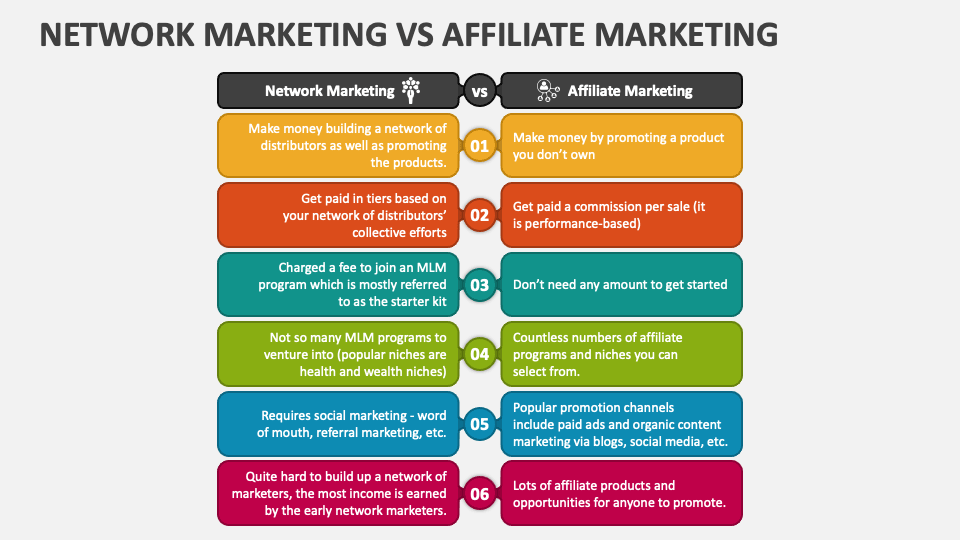
Primary Goals: Affiliate marketing aims to earn commissions by promoting products. MLM focuses on both selling products and building a team through recruitment.
Product Selection: Affiliates can choose from many products across companies. MLM participants usually sell specific products from one company.
Cost to Join: Joining affiliate programs is often free or very cheap. MLMs usually require buying starter kits or inventory, which costs more.
Control Over Work: Affiliates have more freedom in how and when they work. MLM members follow company rules and often must meet sales targets.
|
Aspect |
Affiliate Marketing |
MLM |
|---|---|---|
|
Sales and Recruitment Focus |
Focus on product sales only. No recruitment needed. |
Focus on both sales and recruiting new members. |
|
Income Source |
Earn from commissions on sales. |
Earn from sales and commissions from team sales. |
|
Work Structure |
Flat, no levels or downlines. |
Hierarchical, with levels and downlines. |
Pros And Cons
Affiliate Marketing Advantages include low startup costs and easy entry. You can promote many products without buying inventory. There is a high level of freedom to choose what and when to promote. It can generate passive income after setting up. The structure is simple with no need to recruit others.
Affiliate Marketing Disadvantages are income can be inconsistent and depends on sales. Competition can be tough. You do not earn from building a team. Success requires good marketing skills and patience.
MLM Advantages offer the chance to earn from both sales and recruiting. Earnings can grow quickly with a large team. It provides training and support from the company. Social connections can help build your network.
MLM Disadvantages include high startup costs and inventory requirements. Income depends heavily on recruiting new members. It can face a negative reputation and legal issues. Pressure to sell and recruit can be stressful.
Income Realities
Consistency and Stability differ greatly between affiliate marketing and MLM. Affiliate marketing income depends on product sales, which can fluctuate. MLM income often relies on recruitment and team sales, causing variable earnings. Stability is harder to maintain in MLM because of this dependency.
Recruitment Impact is minimal in affiliate marketing. Marketers earn commissions by promoting products only. MLM requires building a downline, which means recruiting and managing a team. This recruitment affects income growth and workload significantly.
Passive Income Potential is higher in affiliate marketing. Once links and systems are set, commissions can come in without extra work. MLM may offer passive income, but it often demands ongoing effort to support the team and keep sales active.
Common Misconceptions
Affiliate Marketing Myths often confuse people about its simplicity and cost. Many think affiliate marketing requires a large upfront investment. Actually, it usually needs low or no startup cost. Another myth is that affiliates must recruit others; this is untrue. Earnings come mainly from commissions on sales made through unique links. Some believe affiliate marketing is a scam, but it is a legitimate way to earn income online. Success depends on consistent effort and choosing the right products.
MLM Myths include ideas like everyone gets rich quickly. Most MLM participants earn little or lose money. Another false belief is that MLMs only sell products. Recruiting new members to build a team is a big part of income. Some assume MLMs are illegal, but many are legal businesses. However, MLMs often require buying inventory and recruiting others. The structure is complex, with earnings tied to team sales and recruitment. This can make income unstable and harder to predict.
Choosing The Right Model
Personal goals shape the choice between affiliate marketing and MLM. Affiliate marketing suits those wanting flexibility and low startup costs. MLM fits people who like teamwork and direct selling. Risk tolerance varies; affiliate marketing has lower financial risks but variable income. MLM needs more money upfront and carries higher risk due to inventory and recruiting demands.
Time commitment differs too. Affiliate marketing often requires consistent effort to build traffic. MLM may demand more time for training and managing a team. Choosing depends on how much time you can invest and your comfort with sales and networking.
Frequently Asked Questions
How Is Affiliate Marketing Different From MLM?
Affiliate marketing earns commissions by promoting products via unique links. MLM earns from sales and recruiting a team. Affiliate marketing has low startup costs and more freedom. MLM requires inventory, higher costs, and relies on building a sales downline. Income in MLM depends heavily on recruitment.
What Is The Highest Paying Affiliate Marketing?
The highest paying affiliate marketing programs often come from finance, software, and high-ticket digital products. These offer commissions above 30%.
What Is The Most Successful MLM?
The most successful MLM is Amway, known for its global reach and diverse product range. It consistently ranks high in sales and distributor base.
What Is The Downside Of Affiliate Marketing?
The downside of affiliate marketing includes inconsistent income and high competition. Success requires continuous effort and effective marketing strategies.
Conclusion
Affiliate marketing and MLM differ in structure and income methods. Affiliate marketing offers flexibility with low startup costs. MLM requires building a team and involves higher initial investment. Both have unique benefits and challenges. Choose based on your comfort with risk and sales style.
Understanding these differences helps in making a smart decision. Explore what suits your goals and resources best. Keep learning to grow in either path. Success depends on effort and consistency.